America’s maritime industry supports thousands of workers employed aboard cargo vessels, tugboats, barges, offshore drilling platforms, commercial fishing boats, passenger ships, and marine construction projects. While these careers provide rewarding opportunities, they also expose workers to some of the most hazardous working environments in the country.
What Is a Maritime Personal Injury Lawyer?
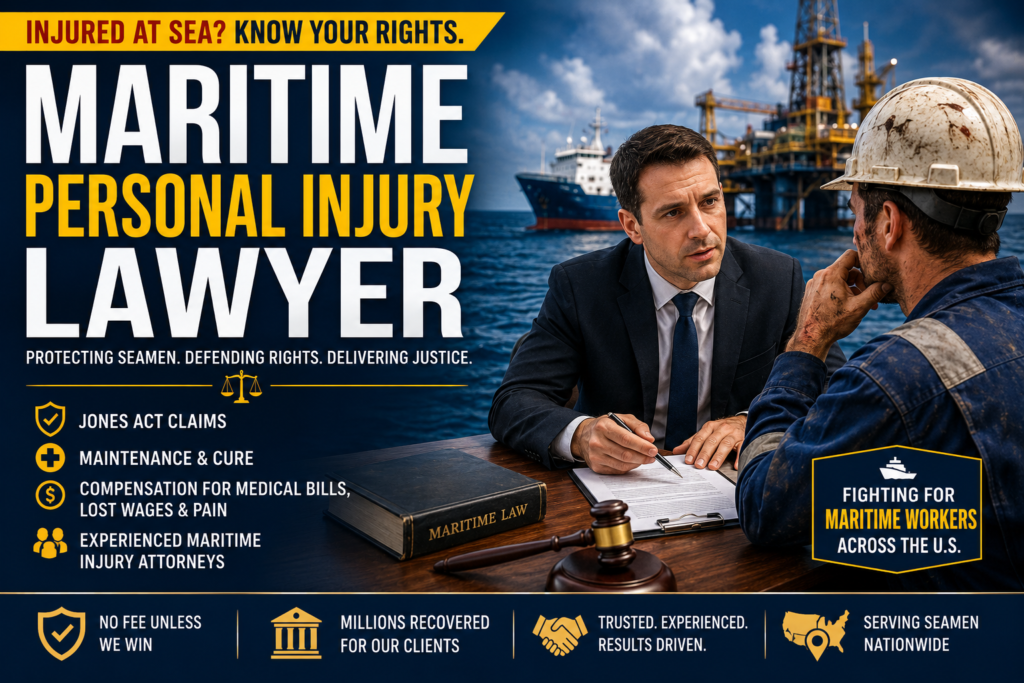
A Maritime Personal Injury Lawyer focuses on representing individuals injured while working aboard vessels or performing maritime-related employment on navigable waters. These attorneys handle claims involving offshore accidents, vessel collisions, equipment failures, unsafe working conditions, and other incidents governed by federal maritime law.
Maritime injury litigation differs significantly from ordinary personal injury cases because several federal laws may apply depending on the worker’s legal status, job responsibilities, and the location where the accident occurred.
An experienced maritime attorney may assist with:
- Investigating offshore and vessel accidents
- Reviewing maintenance records
- Examining vessel safety procedures
- Obtaining witness statements
- Working with maritime safety experts
- Reviewing Coast Guard investigation reports
- Calculating economic losses
- Negotiating with insurance companies
- Representing clients during settlement negotiations or litigation
Because maritime accidents often involve multiple employers, vessel owners, contractors, subcontractors, and insurance carriers, legal investigations can become highly technical and require specialized maritime knowledge.
Who May Need a Maritime Personal Injury Lawyer?
Many individuals working in the maritime industry may benefit from understanding their legal rights after suffering a work-related injury. Whether federal maritime law applies depends on the specific facts of each case.
Common occupations include:
- Merchant seamen
- Deckhands
- Commercial fishermen
- Tugboat crew members
- Barge employees
- Oil rig workers
- Offshore drilling crews
- Marine engineers
- Ship mechanics
- Cargo ship workers
- Harbor employees
- Marine construction workers
- Divers
- Crane operators
- Supply vessel crews
- Offshore maintenance technicians
Each worker’s legal rights depend upon several factors, including employment status, job duties, vessel assignment, and applicable maritime law.
Common Maritime Accidents
Maritime workers face risks every day while operating heavy equipment, navigating changing sea conditions, loading cargo, or maintaining offshore facilities.
Some of the most common maritime accidents include:
- Slip and fall accidents
- Oil rig explosions
- Crane failures
- Falling objects
- Electrical accidents
- Vessel collisions
- Engine room fires
- Heavy machinery accidents
- Cargo loading incidents
- Anchor handling accidents
- Equipment malfunctions
- Chemical exposure
- Confined space accidents
- Helicopter transportation accidents
- Offshore platform accidents
These incidents may lead to severe injuries requiring extensive medical treatment, rehabilitation, and prolonged recovery.
Industries Where Maritime Injuries Frequently Occur
Maritime injury claims arise across numerous industries, including:
- Commercial shipping
- Oil and gas exploration
- Offshore drilling
- Commercial fishing
- Marine transportation
- Port operations
- Shipbuilding
- Ship repair facilities
- Marine construction
- Offshore wind energy
- Pipeline installation
- Harbor maintenance
Each sector presents unique operational risks, making maritime accident investigations highly fact-specific.
Why Maritime Injury Cases Are Different
Unlike ordinary workplace injury claims, maritime cases frequently involve specialized federal statutes, complex jurisdictional questions, multiple responsible parties, and unique legal doctrines such as Maintenance and Cure and vessel seaworthiness.
Determining which federal law applies often requires a detailed review of employment records, vessel assignments, accident reports, medical documentation, and witness testimony.
Understanding these legal distinctions early can help injured maritime workers make informed decisions regarding their claims.
Helpful Government Resources
- Occupational Safety and Health Administration (OSHA)
- U.S. Department of Labor
- United States Coast Guard
- Cornell Legal Information Institute
Related Guides
- Offshore Injury Lawyer
- Jones Act Lawyer (Coming Soon)
- Oil Rig Injury Lawyer (Coming Soon)
- Maritime Injury Attorney (Coming Soon)
Federal Maritime Laws That Protect Injured Maritime Workers
Maritime injury claims are governed by a unique body of federal laws that differ significantly from traditional state workers’ compensation systems. Depending on where an accident occurred, the worker’s duties, and whether a vessel was involved, different federal statutes may determine the legal rights and remedies available.
Understanding which law applies is one of the most important steps in evaluating any maritime injury claim because each statute provides different legal protections and requirements.
The primary federal maritime laws include:
- Jones Act
- General Maritime Law
- Longshore and Harbor Workers’ Compensation Act (LHWCA)
- Death on the High Seas Act (DOHSA)
- Outer Continental Shelf Lands Act (OCSLA)
The specific law that governs a claim depends on the facts of each case, including the worker’s employment status and where the injury occurred.
The Jones Act
The Jones Act is one of the most important federal laws protecting qualifying seamen who are injured while working aboard vessels operating in navigable waters.
Unlike many ordinary workplace injury systems, the Jones Act may allow eligible workers to pursue negligence claims against an employer when the evidence supports such a claim.
A worker may qualify if they:
- Work aboard a vessel in navigation.
- Contribute to the vessel’s mission.
- Spend a significant portion of their employment aboard the vessel.
- Meet the legal definition of a seaman under federal maritime law.
Determining Jones Act eligibility requires a careful legal analysis because every employment situation is different.
General Maritime Law
General Maritime Law consists of long-established legal principles developed through federal court decisions. These principles govern many legal issues involving vessels, navigation, maritime commerce, and offshore employment.
General Maritime Law often works alongside federal statutes and addresses legal concepts such as vessel seaworthiness, maintenance and cure obligations, maritime negligence, and other duties owed to maritime workers.
Maintenance and Cure
One of the oldest protections available to qualifying seamen is known as Maintenance and Cure.
Generally, eligible maritime workers may be entitled to receive reasonable medical treatment (“Cure”) and basic daily living expenses (“Maintenance”) while recovering from work-related injuries until they reach maximum medical improvement.
Eligibility depends upon the facts of the case and the worker’s legal status under maritime law.
Longshore and Harbor Workers’ Compensation Act (LHWCA)
Not every injured maritime employee qualifies as a Jones Act seaman.
Many dock workers, harbor employees, shipbuilders, marine terminal workers, ship repair personnel, and certain waterfront construction workers may instead be covered under the Longshore and Harbor Workers’ Compensation Act (LHWCA).
The LHWCA establishes a federal compensation system for eligible maritime employees injured while performing covered employment near navigable waters.
Death on the High Seas Act (DOHSA)
The Death on the High Seas Act (DOHSA) applies in certain wrongful death cases occurring beyond a specified distance from the United States shoreline.
When applicable, DOHSA establishes the legal framework for pursuing certain maritime wrongful death claims arising from accidents on the high seas.
Outer Continental Shelf Lands Act (OCSLA)
Employees working on offshore oil and gas operations located on the Outer Continental Shelf may have additional legal protections under the Outer Continental Shelf Lands Act (OCSLA).
Because offshore energy operations often involve multiple employers and contractors, determining legal responsibility under OCSLA can require a detailed investigation.
Common Causes of Maritime Injuries
Maritime accidents often result from multiple contributing factors rather than a single event. Thorough investigations frequently identify operational failures, unsafe conditions, or equipment problems that contributed to an accident.
Common causes include:
- Employer negligence
- Unsafe working conditions
- Failure to maintain equipment
- Defective machinery
- Poor vessel maintenance
- Slip and fall hazards
- Crane accidents
- Cargo handling failures
- Explosions and fires
- Electrical hazards
- Chemical exposure
- Improper crew training
- Failure to follow safety procedures
- Mechanical failures
- Confined space accidents
- Weather-related incidents
Who May Be Responsible?
Liability in maritime injury cases often depends on the circumstances surrounding the accident. More than one individual or company may be legally responsible.
Potentially responsible parties include:
- Employers
- Vessel owners
- Marine contractors
- Offshore drilling companies
- Equipment manufacturers
- Maintenance contractors
- Port operators
- Cargo companies
- Subcontractors
- Third-party service providers
Because many maritime projects involve multiple companies working together, identifying every potentially responsible party is often a critical part of a legal investigation.
What Should You Do After a Maritime Injury?
- Seek immediate medical attention.
- Report the accident according to company procedures.
- Document the accident scene if possible.
- Obtain witness contact information.
- Keep copies of medical records and bills.
- Preserve photographs, videos, and equipment information.
- Maintain records of lost income and expenses.
- Understand your legal rights before making important claim decisions.
Helpful Resources
- Occupational Safety and Health Administration (OSHA)
- U.S. Department of Labor
- United States Coast Guard
- Cornell Legal Information Institute
Related Articles
- Offshore Injury Lawyer
- Jones Act Lawyer
- Jones Act Attorney
- Oil Rig Injury Lawyer
- Maritime Injury Attorney
Common Maritime Injuries
Maritime accidents often occur in high-risk environments involving heavy machinery, confined spaces, moving vessels, offshore drilling equipment, cargo handling operations, and unpredictable weather conditions. As a result, injuries suffered by maritime workers can be severe and may require extensive medical treatment and rehabilitation.
The long-term impact of these injuries depends on numerous factors, including their severity, the worker’s occupation, and the applicable maritime laws governing the claim.
Common maritime injuries include:
- Traumatic brain injuries (TBI)
- Spinal cord injuries
- Back and neck injuries
- Broken bones
- Burn injuries
- Amputations
- Crush injuries
- Electrical injuries
- Chemical exposure
- Eye injuries
- Hearing loss
- Respiratory illnesses
- Soft tissue injuries
- Internal organ damage
- Post-traumatic stress disorder (PTSD)
Many of these injuries may permanently affect a worker’s ability to perform physically demanding maritime jobs, making financial recovery an important consideration after a serious accident.
Compensation Available in Maritime Injury Claims
Depending on the applicable federal maritime law and the specific facts of the case, injured maritime workers may have the right to pursue different categories of compensation.
The damages available vary depending on the worker’s legal status, the circumstances of the accident, and the governing law.
Compensation may include:
- Medical expenses
- Future medical care
- Emergency treatment costs
- Hospital expenses
- Prescription medication
- Rehabilitation expenses
- Physical therapy
- Lost wages
- Loss of future earning capacity
- Pain and suffering (where legally available)
- Mental and emotional distress (where applicable)
- Disability-related losses
- Maintenance and Cure benefits for eligible seamen
Because every maritime injury claim is unique, compensation depends on the specific evidence, applicable law, and individual circumstances of the injured worker.
Factors That Influence the Value of a Maritime Injury Claim
No two maritime injury cases are exactly alike. Several legal and factual considerations may influence the overall value of a claim.
Common factors include:
- Severity of the injury
- Length of medical treatment
- Permanent disability
- Future medical needs
- Lost earning capacity
- Worker’s age
- Quality of available evidence
- Witness testimony
- Employer negligence
- Safety violations
- Medical expert opinions
- Applicable federal maritime law
Because each claim depends on its own facts, attorneys cannot ethically guarantee a particular settlement amount or court outcome.
How a Maritime Personal Injury Lawyer Builds a Strong Case
Maritime injury litigation often involves technical investigations and extensive evidence gathering. Experienced attorneys typically work with investigators, engineers, maritime safety professionals, and medical experts to evaluate how an accident occurred.
A legal investigation may involve:
- Reviewing accident reports
- Inspecting vessel maintenance records
- Analyzing safety procedures
- Reviewing Coast Guard reports
- Obtaining OSHA investigation findings where applicable
- Interviewing witnesses
- Reviewing employment records
- Examining medical documentation
- Consulting maritime engineering experts
- Evaluating equipment maintenance history
- Reviewing weather and navigation records
- Analyzing photographs and video evidence
A detailed investigation may help determine the sequence of events, identify contributing factors, and evaluate whether one or more parties may bear legal responsibility.
Evidence That Can Strengthen a Maritime Injury Claim
Preserving evidence after a maritime accident can be important when evaluating liability and damages.
Helpful evidence may include:
- Official accident reports
- Medical records
- Emergency treatment documentation
- Witness statements
- Photographs of the accident scene
- Video recordings
- Maintenance logs
- Inspection reports
- Employment records
- Payroll information
- Safety training documentation
- Communication logs
- Equipment maintenance records
- Vessel logbooks
The quality and availability of evidence often play an important role in evaluating the strength of a maritime injury claim.
Insurance Company Investigations
Following a serious maritime accident, insurance companies and employers often begin investigating immediately. Representatives may request recorded statements, medical authorizations, or additional documentation during the claims process.
Understanding your legal rights before making significant decisions may help ensure that important issues are carefully considered. Every case should be evaluated according to its individual facts and circumstances.
Choosing the Right Maritime Personal Injury Lawyer
Selecting experienced legal representation is an important decision. Maritime law differs significantly from many other areas of personal injury law, making relevant experience an important consideration.
Questions you may wish to consider include:
- Does the attorney regularly handle maritime injury cases?
- Are they experienced with Jones Act litigation?
- Do they understand vessel operations?
- Have they handled offshore injury claims?
- Will they explain the legal process clearly?
- Do they have experience negotiating with maritime insurers?
- Can they coordinate with medical and maritime experts?
- Will they keep clients informed throughout the case?
Choosing legal representation should always be based on your own circumstances, goals, and the specific facts of your case.
Related Articles
- Offshore Injury Lawyer
- Jones Act Lawyer
- Jones Act Attorney
- Oil Rig Injury Lawyer
- Maritime Injury Attorney
- Offshore Injury Law Firm
- Houston Jones Act Lawyer
Helpful Resources
- Occupational Safety and Health Administration (OSHA)
- U.S. Department of Labor
- United States Coast Guard
- Cornell Legal Information Institute
Frequently Asked Questions (FAQs)
What does a Maritime Personal Injury Lawyer do?
A Maritime Personal Injury Lawyer represents individuals injured while working aboard vessels, offshore platforms, tugboats, barges, cargo ships, commercial fishing vessels, and other maritime operations. Depending on the circumstances, claims may involve the Jones Act, General Maritime Law, the Longshore and Harbor Workers’ Compensation Act (LHWCA), or other federal statutes.
Who can file a maritime injury claim?
Eligibility depends on several factors, including the worker’s job duties, employment status, the location of the accident, and the applicable federal maritime law. Different legal protections may apply to seamen, longshore workers, harbor employees, and offshore workers.
What compensation may be available after a maritime accident?
Depending on the facts and governing law, compensation may include medical expenses, lost income, future medical care, reduced earning capacity, maintenance and cure benefits, and other legally recoverable damages.
What is the Jones Act?
The Jones Act is a federal law that provides important legal protections for qualifying seamen injured while working aboard vessels in navigable waters. Whether the law applies depends on the specific facts of each case.
What is Maintenance and Cure?
Maintenance and Cure is a long-established maritime law doctrine that may require certain employers to provide eligible seamen with basic living expenses and necessary medical care until maximum medical improvement is reached.
How long do maritime injury cases usually take?
Every maritime injury case is different. The timeline depends on factors such as the complexity of the accident, medical treatment, available evidence, insurance negotiations, and whether litigation becomes necessary.
Conclusion
Maritime workers play a critical role in global transportation, offshore energy production, commercial fishing, and marine construction. Unfortunately, these industries also expose workers to significant risks that can result in life-changing injuries.
Unlike ordinary workplace injury claims, maritime cases are governed by specialized federal laws that often require a detailed understanding of maritime operations, vessel ownership, employment status, and legal liability.
Whether an injury occurs aboard a cargo vessel, offshore drilling platform, tugboat, barge, or commercial fishing vessel, understanding your legal rights is an important first step. Preserving evidence, obtaining appropriate medical treatment, and learning which maritime laws may apply can help injured workers make informed decisions regarding their claims.
Because every maritime accident is unique, legal outcomes depend on the specific facts, available evidence, and applicable federal law.
Related Articles
- Offshore Injury Lawyer
- Offshore Injury Law Firm
- Oil Rig Injury Lawyer
- Oil Rig Injury Attorney
- Maritime Injury Attorney
- Jones Act Lawyer
- Jones Act Attorney
- Houston Jones Act Lawyer
Official Resources
Occupational Safety and Health Administration (OSHA)
U.S. Department of Labor
Cornell Legal Information Institute
United States Coast Guard
Electronic Code of Federal Regulations
Next Article in the Cluster: Jones Act Lawyer (2026 Guide)